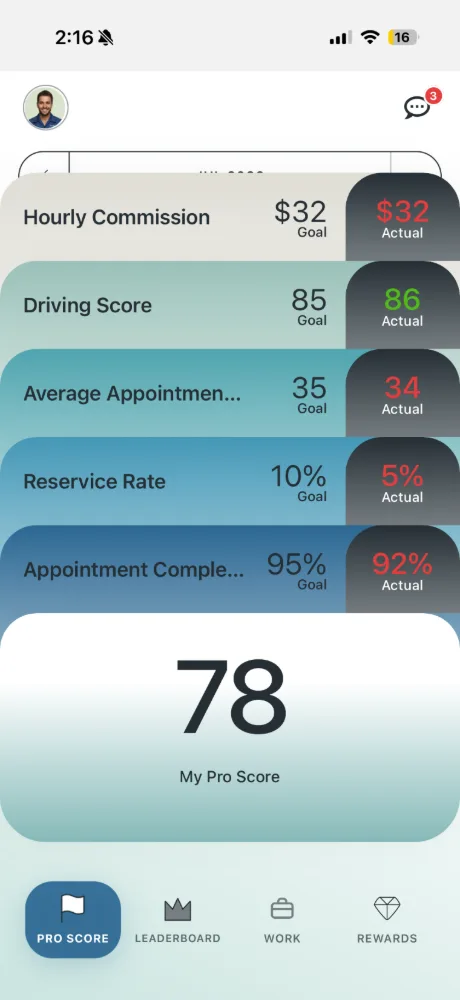
A scorecard only changes behavior if the person being scored can see it. That is the whole idea behind the Pro Score: one composite grade per technician, recomputed as work gets completed, visible to the tech, the manager and the owner at the same time.
What a technician scorecard actually measures
You choose the inputs. Most pest control operators build a Pro Score out of some combination of:
- Production per hour — revenue produced against hours worked, the single most-watched number in the industry.
- Stops per day and completion ratio — is the route actually getting finished?
- Callbacks — the truest quality signal a service business has.
- Cancellations and skips attributable to the route.
- Reviews generated and average star rating per tech.
- Upsells and referrals produced in the field.
- Proof of service compliance — photos, notes and documentation on every stop.
Each input carries a weight you set. A company that is fighting callbacks weights quality heavily. A company pushing growth weights production and upsells. The score is yours to define, and it can differ by role — a first-year tech and a route manager should not be graded on the same curve.
Why daily beats monthly
A monthly performance review tells a technician what they did wrong four weeks ago. A live score tells them what they can fix this afternoon. That difference is the entire return on a scorecard program.
It also changes the manager's job. Instead of hunting through reports to find out who needs attention, the ranking surfaces it. The tech who dropped fourteen points this week is the ride-along you schedule tomorrow.
Competition, without the resentment
Leaderboards work when the scoring is transparent and the inputs are things a technician actually controls. They backfire when the score feels arbitrary or when it is built on numbers the tech cannot see. Driven One shows the full breakdown — every input, every weight, every point — so nobody has to take the number on faith.
Scorecards on top of the CRM you already run
Your CRM knows what was scheduled, what was completed and what was billed. It was never built to turn that into a performance system. Driven One reads what your CRM already tracks and builds the scorecard layer on top of it, so nobody has to double-enter anything and no one has to migrate.
See how Driven One layers on PestPac, FieldRoutes and Briostack.
What changes when the score is visible
Three things, consistently. Documentation improves first, because proof of service is the easiest input to fix. Callbacks come down next, because techs stop rushing the last two stops. And the gap between your best and your worst technician narrows — not because the top performer slows down, but because the bottom of the roster finally knows what "good" looks like.
If you have not settled on what to measure yet, start with the pest control KPIs worth tracking, then decide which of them belong in the score.
Common questions
What is a technician scorecard?
A technician scorecard is a single composite grade that combines the performance metrics a company cares about — production per hour, callbacks, completion ratio, reviews, upsells — into one number per technician, updated continuously so the technician can see and improve it.
How often does the Pro Score update?
Continuously. As work is completed and synced from your CRM, each technician's score is recomputed, so the number a tech sees at lunch reflects the morning's work.
Can I choose which metrics count?
Yes. You define the inputs and the weight each one carries, and you can score different roles on different criteria. A service tech, a sales tech and a route manager can each have their own scorecard.
Do technicians see each other's scores?
That is up to you. Most operators turn on a leaderboard because visible ranking is what drives the behavior change, but individual scores can stay private to the tech and their manager.
Give your team a number they can move.
One platform. One login. One source of truth — for your team, your reputation, and your revenue.
Request a demo