Customer communication in a field service company tends to scatter into four places at once: the office line, the shared email inbox, a technician's personal phone, and whatever the CSR wrote in the account notes. None of those talk to each other, and three of them are invisible to management.
One thread per customer
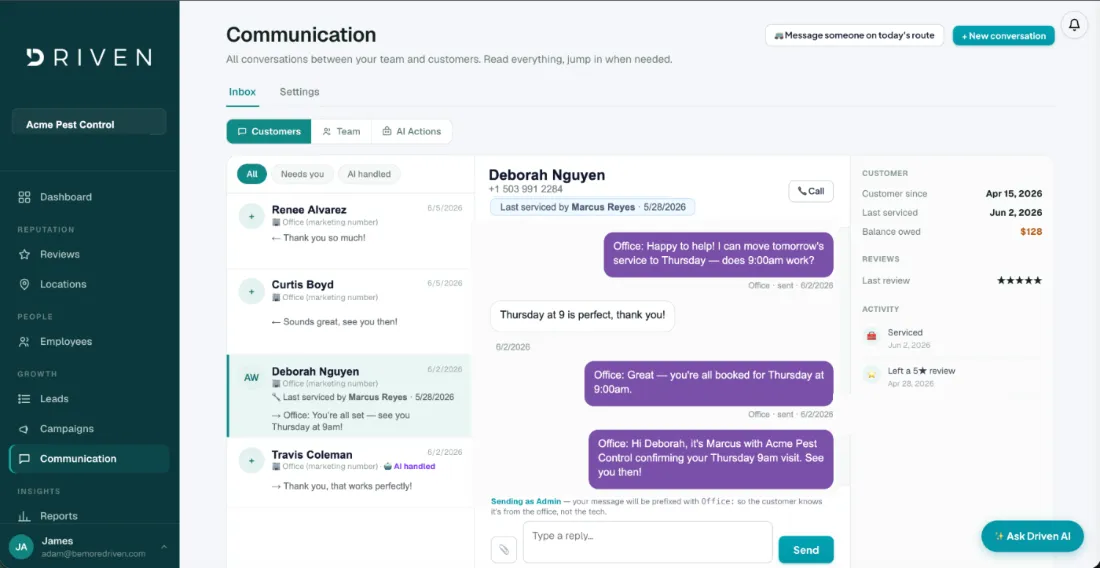
Driven One puts texts, emails and call records into a single thread attached to the customer account. Anyone with permission can pick up a conversation someone else started, which means a CSR covering for a colleague on Tuesday has the full context of what was promised on Monday.
Why the personal-phone problem is worse than it looks
- No record. A promised discount or a rescheduled appointment exists only in one person's messages.
- No coverage. When that person is out, the customer is talking into the void.
- No continuity. When they leave the company, the relationship leaves with them — and in this industry, sometimes so does the account.
- No compliance. You cannot answer a dispute about what was said if the conversation was never yours.
Texting is what customers actually use
Residential pest control customers answer texts and ignore voicemail. Building the shared inbox around SMS is not a preference, it is a match to how appointment changes, gate codes, pet warnings and "can you come earlier" requests actually arrive.
It plugs into the rest of the operation
Because the inbox is part of the same platform as review requests, referral invitations and lead follow-up, the customer experiences one voice from one number instead of four disconnected systems each sending their own messages.
And because your team already lives in Driven One for scorecards and rewards, the inbox is not another app to remember to check.
Team messaging, in the same place
Internal communication runs alongside it. Channels for a branch or a route, direct messages between a manager and a tech, and announcements that reach the whole company — without a separate chat tool that half the field team never installed.
Common questions
Does this give us a business texting number?
Yes. Customer texts run through your company's number rather than an individual technician's personal phone, so the conversation belongs to the business.
Can technicians and office staff both use it?
Yes, with permissions. Technicians typically get their assigned customers and team channels; office staff get the full shared inbox.
Does it record phone calls too?
Call records attach to the customer thread alongside texts and emails, so the whole history sits in one place.
Is team messaging separate from customer messaging?
They are separate surfaces in the same app — a shared customer inbox and internal channels and direct messages — so nobody needs a second chat tool.
Own the conversation, not just the account.
One platform. One login. One source of truth — for your team, your reputation, and your revenue.
Request a demo